
  |
|
May 9, 2024 |
 With the traditional ringing of the bell we bring this meeting to order!
Club member's attendance is recorded by logging in.
Visiting Rotarians may complete a makeup form at the end of this meeting; YOUR donation for making up with us helps fund our service projects!
Visitors are always welcome to browse and register without obligation.
Our club offers the flexibility of ROTARY ON YOUR TIME!
and an opportunity to remain connected with Rotary!

Welcome to this week’s meeting of the eClub of the State of Jefferson.
I am Bob Gibson, President of the Rotary eClub of State of Jefferson. Welcome to this week’s meeting. I hope this finds you well.
One of the items on next week’s Board Agenda will be to set the annual dues for our Club. We have been waiting for confirmation from District 5110 and Rotary International before we finalize our decision. Then, in the next few weeks, you can be expecting an invoice from our Club Treasurer, Carol Ruggeri. Please respond promptly. I appreciate every member of our Club. The invoices may seem more “corporate” than necessary. They are generated by our QuickBooks program and may lack a personal touch. Again, your membership is very much appreciated.
Please mark your calendar for next week’s (May 14) Coffee Chat. Our guest will be Tamim, the Rotary Peace Scholar who recently started his studies in Brisbane, Queensland, Australia. It will be interesting to hear about this amazing experience.
Thank you for your interest in our Club and your commitment to “Service above Self.” Enjoy the meeting.
If you have any questions or comments, I am available. My e-mail address is: bob@bluewaterphoto.net.

email president@StateOfJeffersonRotary.org

eClub Board Meeting
Thursday, May 16th, 8:00 AM
Tuesday at 12:00 PM PDT
 ATTENTION SAN FRANCISCO GIANTS FANS!
The Rotary Club of Scott Valley has an opportunity for you. Check it out!
The Scott Valley Rotary club had a difficult decision at their last Thursday meeting to cancel a fundraiser golf tournament. The golf club requires a certain amount of teams with players that are not members before they can use the golf course. Unfortunately, the club didn't have enough teams. This is one of our biggest fundraisers and missing this fundraiser will be hard.
Hence, the raffle of FOUR great Giants tickets for the May 19th Game
Oracle Park is the ballpark of Major League Baseball's San Francisco Giants.
Address: 24 Willie Mays Plaza, San Francisco, CA 94107
Thank you so much,
Diane Pomeroy, SV Rotary Club
Rotary Club of Scott Valley will use the proceeds for student scholarships
Raffle tickets are $50 each
Contact Diane at 530-468-2707 to purchase tickets
Ticket sales will end May 15th
 Dear State of Jefferson Rotary Members,
We are excited to participate with our young friends in Uganda using digital tools, a perfect activity for our eClub! The children in the Tandi Reading Club will gather on April 27 in Uganda. Before then, my colleague from Uganda and I invite you to record a short video using Flip, a Microsoft tool specifically for educational environments such as schools and this project. We chose it because it is relatively easy to use, but there are some tricky parts, so if you need help, please just drop me an email (remember I’m in Spain, 9 hours ahead of you, so it may take a day for me to respond).
This week, please join our Flip classroom, Uganda Reading Tent. Click here: https://flip.com/6fbbe6c3. You can also scan the QR code instead.
There you will find a video that walks you through the steps to record your message. You can find it here: https://flip.com/s/2ymmd62ey3mb
The children will respond on April 27, and we hope they will see anything you post to respond back to them. Internet can be a challenge in Uganda.
 Weekly eClub "Coffee Chat" Zoom meetings
Tuesday at 12:00 PM PDT
I believe these “fellowship” meetings have been valuable. They are informal opportunities to get acquainted with our members. If it fits your schedule, I look forward to “seeing” you at the meetings.

May is Rotary’s Youth Service Month! Throughout the month, Rotarians, Rotaractors, and younger members of the Rotary family, including Interactors and RYLA and Rotary Youth Exchange participants, celebrate the service, leadership development, connections, and FUN of Rotary’s programs for young leaders.
Every year, over 350,000 young leaders participate in Rotary’s youth programs across Interact, Rotary Youth Leadership Awards (RYLA), and Rotary Youth Exchange. Rotary’s Youth Service Month is an opportunity to promote our young leaders’ local and global impacts and the Rotary and Rotaract clubs that make these programs possible.
Excited to celebrate? Here are four ways to participate:
- Partner with young leaders. Invite youth participants to your Rotary or Rotaract club meetings and together create opportunities for collaboration. Young people are looking for a way to make a difference. Show them how Rotary equips them to do so and join forces as you serve your shared community.
- Start your service-learning journey. Rotary’s approach to youth service, service-learning, is youth-led, hones life skills, and has a lasting impact on communities. Interactive courses and downloadable workbooks are available in Rotary’s Learning Center for adult advisers and youth participants ages 16 and older. Watch this informative video and get started on your service-learning journey today at rotary.org/learn.
- Attend a webinar. As part of the Cultivating Effective Projects webinar series, Rotary International is hosting a webinar on Thursday, 18 May at 18:00 (UTC-5) titled Expanding Reach: Partner with Youth in Service. Learn how to connect and collaborate with youth to increase the impact of your projects and develop youth into leaders.
- Follow along for youth-centered stories. Throughout the month of May, Rotary’s young leaders will be featured across multiple Rotary International platforms. Read the Rotary magazine feature about Interact’s 60th anniversary, subscribe to the Young Leaders in Action newsletter, visit Rotary’s blogs Service in Action and Rotary Voices each week, and follow Rotary’s social media channels to hear directly from youth participants about their Rotary experiences!

District-wide online clubs offer easy entry into Rotary
 Members of Activate Victoria, which uses a club model that attracts members through community service projects.
By Amanda Wendt, past governor of District 9800
During my year as district governor, we wanted to charter a club that would be different and offer a pathway for new Rotarians to pursue their passion for community service and enjoy the benefits of membership without some of the conventional obligations. The club, which adopts a district-wide online model, provides flexibility for members to pursue their own interests and creates a supportive experience for each member.
Members of the Rotary Club of Activate Victoria are not obligated to attend every club meeting or serve on committees if they don’t want to. They are encouraged to support the club in service activities. They can pay their annual membership fees upfront. And they are encouraged to attend district leadership events that align with their leadership journey.
We encourage Activate members to investigate other conventional clubs to find their best fit, seeking a club culture, experience, and resources that will help them make the changes they want to see. But importantly, as members of Activate, they’ll already be Rotarians as they conduct that search.
Many Activate members see themselves as belonging to Rotary as an organization more than members of a single local club. As such, they feel free to run their own projects, work with other Rotary clubs, and even serve in leadership roles in other community organizations.
What I love about this club format is that it offers busy, prospective members minimal obligations so as not to be a barrier to them joining Rotary. It will still provide them with all the benefits of connecting with other volunteers with a heart to give back to their communities. They can gain experience, learn from and share knowledge with others, and pursue their own interests and passions.
Meetings are held online regularly, but these serve mainly as a chance for collaborating on ideas. It is an entirely optional forum to problem-solve and work together to advance ideas or tackle an issue that has arisen. Fees are kept to a minimum, only what is necessary to cover RI dues and district charges. And these are levied through monthly automatic payments from a member’s bank account. The club has no budget of its own; instead, whatever is collected in donations is contributed to joint efforts with partners or to support a common initiative.
I find that clubs like this introduce new members to the Rotary experience while providing them an easy, no-hassle opportunity to explore and connect with other Rotary clubs, grow their leadership skills, work on service projects with other Rotarians, and expand their networks. Our members tell us they find greater fulfilment in this club model and gain experience that resonates with their careers, a significant advantage for people in their 20s, 30s, or 40s. People who have limited time due to other obligations are attracted to this model.
The club, now a year old, is evolving as we learn more about our members’ priorities. We need to continue listening and responding as new members come aboard and expectations shift. While we enjoy a reasonable conversion rate, we work to maintain a steady stream of membership leads from our district.
There are many advantages to chartering a club like Activate Victoria. You will need a strong partnership with your district leadership to share membership inquiries. Remind them that members who join an introductory club like this could be taking their first steps to a more conventional club in your district. Time spent finding the best Rotary fit is always time well spent and increases the chances for a fully engaged and committed long-term member of Rotary.

WHO South-East Asia Region celebrates 10 years certified polio-free
27 March marked 10 years since the World Health Organization certified the South-East Asia Region free of wild poliovirus. This milestone would not be possible without the tireless efforts of health workers, national and local leaders, our partners, and, of course, Rotary members all around the world. Thank you!
In honor of this anniversary, Global Citizen interviewed Deepak Kapur, chair of the National PolioPlus Committee in India. Jayant Kulkarni, a past governor of District 3141 (India), wrote an article about Rotary’s role in polio eradication in India. Hamid Jafari, director of polio eradication for the WHO Eastern Mediterranean Region, also wrote a reflection on his time working in India leading up to the eradication of wild polio there.
Polio mapping goes high tech
Did you know that one of the most powerful new tools for stopping polio outbreaks fits in your pocket?
Vaccinators in Republic of the Congo use geospatial tracking through a mobile app to ensure that no child is missed by their outbreak-response vaccination campaigns.
Rotary, UNICEF recognize a milestone in our partnership
On 31 January, Rotary and UNICEF celebrated a momentous milestone: Rotary’s cumulative support to UNICEF reached US$1 billion. Our partnership has helped reduce polio cases by 99.9% since 1988, and we remain committed to our continued efforts to make the dream of a polio-free world into a reality.

Navajo Solar Lights
Bringing solar powered lighting to at-risk populations on the Navajo Reservation.
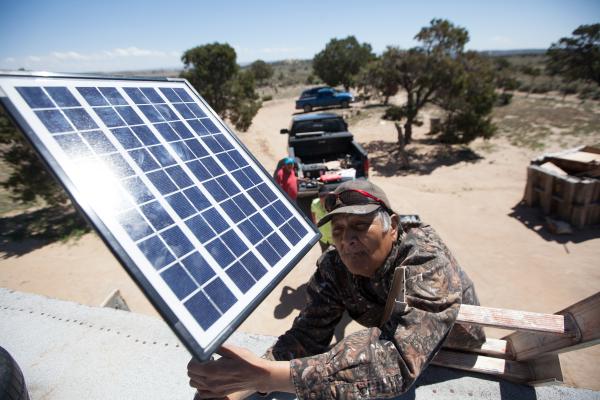
The Navajo Solar Light Project is a program that brings solar powered lighting to at-risk populations on the Navajo Reservation, including elders over 70 years old. The project was initiated by the Rotary Club of Durango Daybreak by Joe Williams.
The Navajo Nation, bigger than the state of West Virginia, sprawls across Arizona, Utah, and New Mexico. It is a harsh but beautiful land.
Over 15,000 Navajo homes don’t have access to electricity. Nearly a third have no running water, and more than half lack kitchen and toilet facilities.
A solar panel the size of a baking sheet mounts onto a roof with a pole. A wire runs from the panel into the house where up to three rechargeable lights hang from hooks on the ceiling. To turn on the lights, the resident need only touch a button. The light can be detached and used as a flashlight for going outside at night. The kit includes a charging outlet for cell phones which enhances the resident’s safety and contact with family. Each solar light kit costs about $300.
The impact of the COVID pandemic on Navajo children has been significant. Children have been out of school and many lack reliable internet for access to online education.
Chinle Plants Hope (CPH) is a project that can take the Navajo Solar Lights Project to a new level, offer significant assistance to the Navajo people and meet the challenges of Covid. It is a community-based program that is also being supported by the Durango Daybreak (CO) and Glenwood Springs (AZ) Rotary Clubs.
This project will expand the reading and learning opportunities for both the children and the community of Chinle, Arizona.
Now, and for the past 9 years, Rotarians led by the Rotary Club of Durango Daybreak have teamed with the Navajo Nation to bring solar lights to remote, off-the-grid homes on the country’s largest Native American reservation. Volunteers from all over the United States have not only pitched-in to make solar light a reality to Navajo residents but have had the opportunity to sample regional food and learn about a vastly different culture. Among the Rotary Clubs that have supported this project are:
- The Rotary eClub of the State of Jefferson
- Durango High Noon Rotary Club (CO)
- The Rotary Club of Eugene Airport (OR)
- Boise Rotary Club (ID)
- Denver Rotary Club (CO)
- Rotary Club of the Caldwells (NJ)
- Rotary Club of Five Points (SC)
In addition, an important part of the project has been to involve local Interact Clubs and Youth Exchange students.


How the Memory of a Song Reunited Two Women Separated by the Trans-Atlantic Slave Trade
In 1990, scholars found a Sierra Leonean woman who remembered a nearly identical version of a tune passed down by a Georgia woman’s enslaved ancestors

In 1933, the pioneering Black linguist Lorenzo Dow Turner met an elderly Gullah Geechee woman named Amelia Dawley in a remote coastal village south of Savannah, Georgia. While Turner recorded, Dawley sang a song of unknown origin, passed down through the generations by her ancestors. Dawley didn’t know the song’s meaning, but a Sierra Leonean student who heard the recording recognized its lyrics as Mende, a major language in his home country. Turner published an English translation of the song in his 1949 book, Africanisms in the Gullah Dialect.
Decades later, anthropologist Joseph Opala came across Turner’s work. He eventually decided to travel through Sierra Leone with ethnomusicologist Cynthia Schmidt and native linguist Tazieff Koroma in an attempt to trace the provenance of the mysterious lyrics. After a long, fruitless search through humid country, Schmidt ended up in the isolated village of Senehun Ngola, where she met a local woman who had preserved a shockingly similar song that traced back hundreds of years.
“[Her] grandmother had taught her the song, and she had kept it alive by changing the words for other occasions,” says Schmidt.
Located on the Windward Coast of West Africa, the region now known as Sierra Leone was a key player in the trans-Atlantic slave trade. Westerners also referred to the area as the Rice Coast; as English abolitionist Thomas Clarkson wrote in 1788, the red rice found there was “finer in flavor, of a greater substance, more wholesome and capable of preservation, than the rice of any other country.”

When slave traders arrived in Sierra Leone, they found a lush country of verdant forests, knobby mountains and waters thick with aquatic life. Cultivated rice fields and wild indigo sprawled across the landscape. Massive mangrove trees crowded the riverbanks, rendering certain villages “scarcely perceptible” and protecting their inhabitants from potential enslavers, who could pass “within a few yards of a town” and not suspect anything, wrote English physician Thomas Masterman Winterbottom in 1803.
Bunce Island, where captive West Africans were held in a stone fortress before being forced onto slave ships for the deadly journey across the Middle Passage, served as the center of the region’s slave trade. In 1791, Anna Maria Falconbridge, the wife of an English abolitionist, wrote about the unforgettable “sight of between two and three hundred wretched victims, chained and parceled out in circles, just satisfying the cravings of nature from a trough of rice placed in the center of each circle.”
In North America, wealthy rice planters whose plantations lined the Lowcountry—a region along Georgia and South Carolina’s coast that includes the Sea Islands—paid a premium for enslaved people from Sierra Leone. When slave ships docked, local newspapers reported their arrivals and made sure readers knew the enslaved people on board were from a part of Africa famed for its rice cultivation. A 1785 advertisement published in Charleston, South Carolina, for example, touted the sale of “Windward Coast Negroes, who are well acquainted with the culture of rice, arrived from B[u]nce Island.”
Between about 1750 and 1800, the slave trade brought thousands of West Africans to the Lowcountry, whose Sea Islands resembled the marshes of their homelands. These individuals’ diverse languages melded together, and a distinctive patois and culture started to emerge. Known as the Gullah Geechee, the community has preserved remnants of its African heritage through food, rituals and art—including Dawley’s ancestral song.
Turner, the scholar who first recorded Dawley’s melody, counted Zora Neale Hurston among his students. The Harlem Renaissance author later remembered Turner as the professor “who most influenced me,” a handsome, soft-spoken “Harvard man [who] knew his subject.”
After a chance conversation with two students at what is now South Carolina State University, where he was teaching summer school in 1929, Turner decided to focus his fieldwork on Gullah language and culture. Walking along the Lowcountry, Turner interviewed descendants of the enslaved, made careful notes about their dialect and songs, and took photos. Turner’s first wife, Geneva Townes Turner, helped him record Gullah sounds and even enrolled in phonetics classes to prepare for the research.
Musicologist Lydia Parrish, who was also studying the music of the formerly enslaved, drew Turner’s attention to Dawley’s song. In the summer of 1933, he met 52-year-old Dawley and her 11-year-old daughter, Mary, in Harris Neck, Georgia. Dawley told Turner about a song passed down by her paternal grandmother, Catherine, who had survived the Middle Passage and was enslaved by a Georgia plantation owner. Catherine had several children with her enslaver, including Dawley’s father, Mustapha Shaw, who served a soldier in the 33rd Regiment of the United States Colored Troops during the Civil War.
After Union Major General William Tecumseh Sherman completed his famous March to the Sea from Atlanta to Savannah in late December 1864, he issued a special order that set aside 400,000 acres of captured Confederate territory for redistribution to Black families. The plan didn’t last: President Andrew Johnson rescinded it in the fall of 1865, returning the land to its original owners. Shaw was one of the many freedmen who fought back against the reversal, which the newly emancipated “understood as an assault on their hard-won freedom,” wrote historian Allison Dorsey in a 2010 essay. But Shaw’s efforts were unsuccessful, so he returned his birthplace of Harris Neck, buying ten acres from none other than his father and former enslaver.

Turner’s July 31, 1933, recording finds Dawley sharing her family song, which helped her remember her mother, Tawba Shaw, and her paternal grandmother. Today, the aluminum disc is housed at Indiana University’s Archives of Traditional Music alongside 835 other recordings made by Turner between 1932 and 1960.
Until his death in 1972 at age 77, Turner remained dedicated to the study of Gullah and similar languages. His groundbreaking research showed that Gullah, long dismissed by white observers as simply “bad English,” was actually derived from more than 30 African languages.
The dialect’s existence speaks to “the strength of the people brought here as slaves,” Alcione Amos, curator of a past exhibition about Turner at the Smithsonian’s Anacostia Community Museum, told Smithsonian magazine in 2010. “They couldn’t carry anything personal, but they could carry their language. They thought everything was destroyed in the passage. But you can’t destroy people’s souls.”
Turner’s work was foundational for subsequent Black language scholars, including Opala, the anthropologist who identified the African counterpart to Dawley’s song. After graduating from college in 1974, Opala joined the Peace Corps, which shipped him off to Sierra Leone, where he worked with rice farmers before shifting focus to archaeology.
“The U.S. ambassador at that time, Michael Samuels, urged me to do an archaeological survey of Bunce Island”—the first of its kind, says Opala. Begun in 1976, the excavations “led to my efforts to find out where the enslaved people shipped from that island were taken.”

Ethnomusicologist Schmidt was teaching at Sierra Leone’s Fourah Bay College when Opala requested her help in studying Turner’s recordings of Gullah stories and songs. The pair spent six years collaborating with Sierra Leonean linguist Koroma and Mende man Edward Benya to reconsider and correct Turner’s original translation. Ultimately, the group settled on this phrasing:
A wa ka, mu mone; kambei ya le’i; lii i lei tambee
A wa ka, mu mone; kambei ya le’i; lii i lei ka
Haa so wolingoh sia kpande wilei
Haa so wolingoh, ndohoh lii, nde kee
Haa so wolingoh sia kuhama ndee yia
Translated into English, the lyrics read:
Everyone come together, let us struggle; the grave is not yet finished; let his heart be perfectly at peace.
Everyone come together, let us struggle; the grave is not yet finished; let his heart be very much at peace.
Sudden death commands everyone’s attention like a firing gun.
Sudden death commands everyone’s attention, oh elders, oh heads of the family.
Sudden death commands everyone’s attention like a distant drumbeat.
The breakthrough came when Koroma recognized a word from the song as a Mende dialect from southern Sierra Leone. In 1990, the researchers traveled around the country’s Pujehun District, playing the song for villagers in hopes of finding someone who recognized the words. Schmidt says she and her colleagues acknowledged that this was a “remote possibility,” but after many weeks, they found a small village, Senehun Ngola, and a woman named Baindu Jabati who astonished them by singing a nearly identical version of the song.

Jabati revealed that the tune—taught to her by her grandmother—was originally a funeral elegy. As Jabati explained in the 1998 documentary The Language You Cry In, her grandmother said that “those who sing this song are my brothers and sisters.” Given the similarities between the two songs, the researchers concluded that Dawley’s ancestors hailed from this specific area of Sierra Leone.
Schmidt and Opala reached out to Dawley’s daughter, by then married and known as Mary Moran, to share their discovery. But the outbreak of the Sierra Leone Civil War in 1991 prevented Moran and Jabati from connecting in person. During the conflict, Jabati was enslaved by rebels, who killed several of her family members and razed her village. By 1997, the war had eased enough for Moran to travel to Senehun Ngola, where her meeting with Jabati was recorded for The Language You Cry In.
Anthropologist Joseph Opala and Ethnomusicologist Cynthia Schmidt were the ones who — after hearing Dr. Turner’s recording — went to Sierra Leone to search for anyone who might recognize the lyrics sung in America by a Gullah Geechee family at least 200 years. pic.twitter.com/Q15HUGfSFp
— GullahMuseumSC (@GullahSc) September 6, 2020
The documentary concluded with a message from the village’s blind, 90-year-old chief, Nabi Jah, who encapsulated hundreds of years of trauma by saying, “You can identify a person’s tribe by the language they cry in.”
Since the song contains about 50 words, it’s “almost certainly the longest text in an African language ever preserved by an African American family,” says Opala. “By comparison, [Roots author] Alex Haley was led to his roots in the Gambia by about five or six words in Mandinka.”
In her 1986 book, Radiance From the Waters: Ideals of Feminine Beauty in Mende Art, art historian Sylvia Ardyn Boone wrote that the Mende people remember “a vast storehouse of information” through the use of song. According to Boone, when someone dies, “the ear remains alive.” The Mende repeat the mantra “Ngoli nda ii haa ma,” which translates to “There is no death [within] the ear.”
In addition to shedding new light on Dawley’s story, Opala joined other scholars in tracing the ancestry of a 10-year-old African girl named Priscilla, kidnapped in 1756 from Sierra Leone, to a 21st-century woman living in South Carolina. Today, Dawley’s family keeps her legacy alive with repeated visits to Sierra Leone and ongoing charitable support. “The 1619 Project” miniseries, based on the New York Times investigation of the same name, shared the story of Dawley’s father, Shaw, and featured interviews with some of her descendants.
Identifying the origins of Dawley’s song “solidifies my identity, because I know where I came from,” says Dawley’s great-nephew, Winston Relaford. “I am no longer another person with a general origin. I now know who I am.” For Relaford and his relatives, the lyrics mean neither “slavery nor the width or depth of the ocean could keep [them] separated” from their Sierra Leonean heritage.
In addition to shedding new light on Dawley’s story, Opala joined other scholars in tracing the ancestry of a 10-year-old African girl named Priscilla, kidnapped in 1756 from Sierra Leone, to a 21st-century woman living in South Carolina. Today, Dawley’s family keeps her legacy alive with repeated visits to Sierra Leone and ongoing charitable support. “The 1619 Project” miniseries, based on the New York Times investigation of the same name, shared the story of Dawley’s father, Shaw, and featured interviews with some of her descendants.
Identifying the origins of Dawley’s song “solidifies my identity, because I know where I came from,” says Dawley’s great-nephew, Winston Relaford. “I am no longer another person with a general origin. I now know who I am.” For Relaford and his relatives, the lyrics mean neither “slavery nor the width or depth of the ocean could keep [them] separated” from their Sierra Leonean heritage.
weekly@StateOfJeffersonRotary.org

How to Record Phone Calls on an iPhone
Apple doesn't make it easy to record calls on an iPhone. Here are some of your best options.
You want to record a call on your smartphone. Maybe it's an interview for work, a customer service call, or a conversation with a loved one.
Things get tricky when you want to record a call while using an iPhone. (And it's not quite as easy on Android anymore, but certainly possible.)
You would think there'd be an iOS app for that, but Apple doesn't allow third-party apps to access the microphone and the integrated Phone app directly. However, there are tricks within some apps and services to get around that limitation and make you a mobile wire-tapping master.
Be sure to tell the person on the other end of the line you're recording. Depending on your location, you may be breaking a law if you don't. Some US states—like New York and even the feds—only require one-party consent, which means you can record without telling the other person or persons. In California, all parties must know they're being recorded—even if the recorder is out of state. Under federal law, one-party consent is okay, but only if you're part of the conversation; otherwise that's considered eavesdropping.
None of these laws are as cut and dried as they seem (Nevada's one-party consent has been viewed by the courts as an all-party consent). Play it safe and get permission on any recorded call. "Forgiveness" could get litigious and costly, and even lead to criminal charges. If you're nervous, don't record at all. The folks at Rev did a deep-dive into the laws to help drive that advice home.
Simply Record a Speakerphone Chat
This works for any call, live conversation, or endless Zoom meeting. On a second device—be it another iPhone, an iPad, a laptop, or an Android device—open a voice-recorder app and hit record while you're talking. On iOS, the built-in version is called Voice Memos; we have a full tutorial on how to use it. Windows has a built-in Sound Recorder. Android has a bunch of them.
You can do this with third-party voice recorder apps as well, like Rev, Otter, and Alice, which offer some transcription. Usually for a price. The downside to this method is the quality can be sketchy. Plus, people hate talking on speakerphone.
Employ Google Voice
If you haven't used that Google Voice account in a while, check it out. With a Gmail account, it provides free voice mail, a free phone number, call-around service (it'll ring as many IRL phones as you want it to until you answer), and yes, even conversation recording on incoming calls. While it's possible to make an outbound call using the Google Voice app on your iPhone, you can't record them.
For recording to work, it must be activated in settings. In the mobile app or via voice.google.com on the desktop, go to Settings > Calls > Incoming call options.

You have the option in settings for calls to be answered either via the app itself (check off iOS Device) or by having the call forwarded to your mobile number. Either way, you are not technically doing the recording on your iPhone. It's all done on Google's servers, which handle the Voice over IP (VoIP) connection.
When you answer calls made to your Google Voice number, tap 4 on the number pad. Participants will hear a robot voice state that recording has begun—this is Google's way of keeping you legal; Alphabet Inc. wants no part of a lawsuit. To stop recording, tap 4 again or hang up. You can hit the 4 key as often as you like to start and stop recording.
Call recordings are forwarded to you via email and appear in Google Voice's list of voicemail recordings. You can generally tell the difference between voicemail messages and recorded conversations because the latter are longer and say "Transcription not available."
If you want to do this with a Google Workspace account, you'll need to have the admin set it up, and that'll cost a few bucks per month. An admin can actually set it so all calls are recorded, but both parties will hear a warning if that happens.
Use a 3-Way Call Merge App
On iPhone, recording phone calls is blocked, period. The apps that do exist to record a call—and there are quite a few—provide a workaround. It will usually cost you.
iPhone recorder apps only work because they utilize 3-way conference calls, either incoming or outgoing. The third "caller" is a recording line, provided as a service by the app's developer. 3-way calling is a must-have feature of your iPhone for this to work, so be sure your carrier supports it. In the US, the big three all do.
A downside to these apps: they are not as simple as hitting a key on the number pad. You have to take extra steps to make the merge happen with the third number doing the recording. However, they can be activated in the middle of any normal phone call; afterward, you get easy access to recordings in the app and can play, download, share, or export them as desired.
Rev, a top-rated transcription service, offers an app to facilitate recording incoming and outgoing calls by merging in a Rev recording number on a 3-way call. You access the recordings in the Conversations area of the app.
Unlimited recording is free with Rev's service, there's unlimited storage, and you can share the recording all you want. It only charges for transcriptions (it's $1.50 per minute but offers top-notch accuracy, according to our review). The Rev Call Recorder app, only on iOS, is free. Don't confuse it with the Rev: Record & Transcribe voice recorder mentioned above (also free, for iOS and Android), which is for recording in-person conversations.
Most similar apps will cost you for the recording alone and some limit recording time.
-
Cube Call Recorder (iOS and Android) is an app that records calls. It'll even work with VoIP apps like Skype, WhatsApp, and Telegram on Android. Premium cost is $7.99 a week or $49.99 a year to get unlimited call recordings.
-
TapeACall (iOS and Android) is $10.99 monthly or $59.99 per year for unlimited recordings at any length. It also offers transcriptions. There's a 7-day free trial.
-
Call Recorder Pro (iOS only) is a $9.99 one-time purchase, but offers only 300 minutes of calling credits; do an in-app purchase of credits to record after that. There's a "lite" version to try out with limited record times (60 seconds) and features.
Dial 3-Way Call Recorder Services
You don't need an app to record calls. There are several paid services that let you call them directly to get the recording going before you pull in the other party. This also means you're not limited to iPhone only—they'll work with an Android phone or even a landline.
RecordiaPro has options for recording both in the US alone (starting at $29.99 for 120 minutes) or worldwide ($40 for 190 minutes). Create an account before you call, put RecordiaPro's number in your contacts, and use it when you call out or add RecordiaPro to existing calls. For $36 per year, it will provide a number you can hand out to take future calls that get auto-recorded. Transcription costs extra.
Recordator has a free 10-minute recording trial; otherwise, it costs $10 for 67 minutes to start, then costs $0.15 per minute, but there are no monthly fees, just per-minute-used fees. It works much like RecordiaPro, giving you a number to set up a 3-way conference that does all the recording. It also supports the merge-call option.
Use Your Own Voice Mail—Maybe
If your iPhone has support (via your mobile carrier) for 3-way calling and Visual voice mail, you have an option for the cheapest workaround of all.
When you're on a call, wait for the Add Call button to light up, so you can add a third caller via 3-way calling. Tell the other person to wait, click the button, and call yourself. Stay on the line and listen to your own voicemail greeting, then for the tone that indicates the recording has begun. Tap Merge Calls. All three calls are merged—and the third one (your voicemail) is taping the other two.
Later, you can access the recording like you would any other voicemail message. If you desire, export voice mail messages as audio files.
This isn't going to work for all carriers. On mine (AT&T), calling my own number dumped me into the audio voicemail menu and didn't record. You could always try calling the person on the other line again—you'll go directly to their voicemail, certainly. They could send you the recorded "voice mail" conversation after. However, that's not something most interview subjects want to get involved in.
Also, carriers have a limit to how long they'll let you record a voicemail message. Test it with your phone and a friend before you trust this method.
The safer option is to do this with a third-party voicemail system like Google Voice (but the voicemail recordings are limited to 3 minutes). Ultimately, it's better to have a paid voicemail service, use the Google Voice recording option for incoming calls outlined above, or spring for paid recorder services like Recordator. Especially if you're going to talk for a long time.
The Hardware Options
It seems foolish to buy more hardware to record from the iPhone—the most advanced hardware in your pocket, if not your entire home. But the option exists.
The simplest, lowest-tech option—beyond operating a handheld voice recorder while you blather over the speakerphone—is a cable: the Olympus TP-8 Telephone Pick-up Microphone for under $20. It doesn't digitally capture from your iPhone. Instead, it has a microphone built into the earpiece. Plug the 3.5mm plug on the other end into a recorder. Hold the iPhone up to your ear to talk normally. The TP-8 captures each side of the conversation from what comes out of the iPhone's ear speaker, while you can still hear the conversation.
Obviously, your recorder must support input via a 3.5mm microphone jack, such as the highly rated $60 Sony ICD-PX470 Stereo Digital Voice Recorder. It has almost 55 hours of battery life, records to a microSD card, and connects to a PC via USB-A.

A digital recorder is nice and all, but remember, if you plug a recorder directly into an iPhone, you're not going to hear the call. Using the iPhone headphone jack—assuming your iPhone is so old that it even has one—cuts off the speaker. Get the Recap, a $99 adapter that plugs into an older phone's 3.5mm jack, with output to a headset as well as to a recorder. The secondary recorder—connected via a 3.5mm male-to-male auxiliary audio cable—is up to you. It could even be another iOS device or an Android or a PC.
An option with far fewer cables is the RecorderGear PR200. It records your conversation via Bluetooth. The call button in the middle of the device can answer calls on the Bluetooth-connected phone. Hold the PR200 up to your head to talk and listen, as if it's the phone. It also features a USB-A plug on the end to quickly access recordings on the computer. It will hold about 288 hours of conversation before it fills up the 8GB of storage. It records like any digital recorder sans smartphone, since it has an external pin-hole microphone.
Wondering how to get an extra phone number to use with your smartphone? Read How to Get a Secret Phone Number (and Why You Need One). And if you're only recording in-person conversations, check out The Best Voice Recorder Apps.
weekly@StateOfJeffersonRotary.org
You are not authorised to post comments.