Open menu


2025 2026 Unite for Good Beclub logo d5110

February 12, 2026

ClubBellWith the traditional ringing of the bell we bring this meeting to order!

Club member's attendance is recorded by logging in.

YOUR donation for making up with us helps fund our service projects!  

Visitors are always welcome to browse and register without obligation. 


Our club offers the flexibility of   ROTARY ON YOUR TIME!

and an opportunity to remain connected with Rotary!   


 Welcome to this week’s meeting of the eClub of the State of Jefferson.

Hello eClub Members, welcome to this week’s weekly meeting.

So very sorry for my absence. The best part is that I belong to the State of Jefferson Rotary eClub, and I can attend a meeting or Coffee Chat wherever I am!

I hope you all enjoy this week’s meeting, and if you don’t hear from me for a couple of weeks, it just means I am enjoying family and friends.

Yours in Rotary,
Jackie


2025 2026 Unite for Good B

Jackie Oakley
2025-2026 Club President

The Four-Way Test

The Four-Way Test is a nonpartisan and nonsectarian ethical guide for Rotarians to use for their personal and professional relationships.
The test has been translated into more than 100 languages, and Rotarians recite it at club meetings:

Of the things we think, say or do

  1. Is it the TRUTH?
  2. Is it FAIR to all concerned?
  3. Will it build GOODWILL and BETTER FRIENDSHIPS?
  4. Will it be BENEFICIAL to all concerned?


email president@StateOfJeffersonRotary.org


Our district is seeking two Rotarians willing to serve in vital leadership roles:

  • District PolioPlus Chair
    • District Grants Chair

As District PolioPlus Chair, you help champion one of Rotary’s greatest humanitarian achievements: the global effort to eradicate polio. Your leadership helps keep awareness strong, inspires giving, and reminds the world what Rotary can accomplish together.

As District Grants Chair, you help clubs turn great ideas into meaningful service — supporting projects that improve education, health, clean water access, and community well-being right here in our district and beyond.

If you have a passion for service, enjoy connecting with others, or want to make a lasting difference beyond your own club, one of these roles may be your next opportunity to lead.

If you’re interested — or would like to learn more — please reach out to me or DRFCC Rick Olson directly. I’d love to have a conversation.

Christine Waugh
Governor, District 5110
Leader Support Service
Voice or text: (541) 270-0399


eClub Board Meeting
February 12th, 2026 8:00 AM PST


Valentines Day, celebrated annually on February 14th,
is a global holiday dedicated to expressing love and affection, often through exchanging cards, flowers, chocolates, and jewelry.
Originally a Christian feast day honoring Saint Valentine, it has evolved into a popular cultural celebration for couples, friends, and family to honor relationships.
In 2026, it falls on a Saturday. 


Weekly eClub "Coffee Chat" Zoom meetings
Tuesday at 12:00 PM PDT

 These “fellowship” meetings are informal opportunities to get acquainted with each other.  If it fits your schedule, we look forward to “seeing” you at the meetings. Enjoy talking about "stuff" like water witching/dowsing, green flashes at sunset, Christmas in Pakistan, and much much more.


February is Peace and Conflict Resolution Month 

 
February Peace Conflict Prevention MonthFebruary is Peace and Conflict Resolution Month 

Conflict and violence are unfortunately all too common in our world, leading to displacement and suffering for millions of people, particularly women and children. The Rotary family is dedicated to addressing the root causes of conflict, such as poverty, lack of education, and unequal distribution of resources, and works tirelessly to build peace and prevent conflicts from escalating.

As we step into February, I am delighted to invite you all to join in marking Rotary's Peacebuilding and Conflict Prevention Month. This is a special time for us as a district to highlight the meaningful role we play in fostering peace in our communities and around the world.

Throughout February, we encourage each Club to celebrate and promote peace-focused projects, educational events, and community dialogues. Please check out https://rotary.org/en/our-causes/promoting-peace. There is an impactful short video along with other resources to inspire action. I have also attached a brochure on the ways Rotary Promotes Peace. Please spread the word!

We believe that every small action contributes to a more peaceful world. Thank you for making February a month of meaningful impact.

In service and peace, 
Michelle Corradetti
District 5110 Governor Nominee 
District 5110 Peace Chair
Rotary International


Report on the Reading and Writing Tent for Children

2026 Uganda Reading 06

The tent was held in Zzana village on Entebbe Road.

It was held on Saturday December 20, 2025.

It started at 10:00 am in the compound of the Village local council chairperson.

They were 13 learners from different classes; beginning from baby to those in form 3. (3 – 15 years)

We had three facilitators to help.

As stipulated in the agenda, Learners were welcomed to the venue since most of them were from the neighborhood. (Ms. Annette)

One of the learners said a prayer and introductions began.

The learners shared their names, class and school.

The facilitators also told the learners their names and where they work.

Ms. Annette informed the learners why developing a reading habit is important for both exceling in school and being able to survive in the world as a literate person. She asked the learners to share any information they had about reading and its advantages. Two learners shared and informed the group that they were able to read sign posts on the roads and items in the supermarket.

She introduced the day’s activity with proper instructions.

The first activity was a Read Aloud by Ms. Annette

  1. A Read Aloud by the facilitator
  2. Choose an activity; Art or Write a story
  • Draw the cover of why developing a reading habit is important
  • What a story of your choice
  • Write another ending of the story that has been read

The exercise started with the distribution of stationery and pupils were working on their chosen activity. They were given 30 minutes to accomplish the activity.

2026 Uganda Reading 01  2026 Uganda Reading 02  2026 Uganda Reading 04

There was also an activity about spelling of words. This involved getting small words from a given big word.

This was so interesting because some children created words that had no meaning and for others no one had ever heard of them. This session was so argumentative as pupils were convincing others that their words were correct. The dictionary had to be close by.

The young ones were busy coloring some pictures that they were given.

2026 Uganda Reading 016  2026 Uganda Reading 015  2026 Uganda Reading 017

The other activity for the starting and ending of the story differently was another interesting task.

The rain disrupted the remaining activity but this did not stop us from continuing in the seating room of the chairperson.

We would hear Learners enjoying what they are doing.

It was about “my starting or ending would be the best.”

Those that had presentations to make, that was the time.

Everything was done including the awarding of the spelling certificate to the best speller.
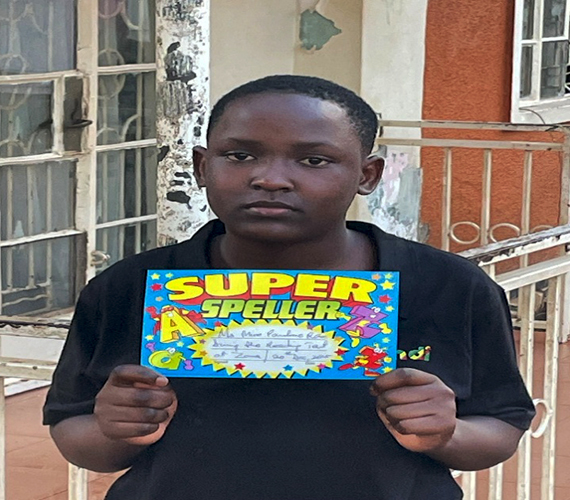
2026 Uganda Reading 019

The activity ended with a snack for all and the participants and facilitators.

We would like to thank the Rotary eClub of the State of Jefferson for all that they helped the Ugandan children to achieve.

Annette Kiberu
Director Tandi Reading Club


2026 Uganda Reading 03  2026 Uganda Reading 013  2026 Uganda Reading 07


2026 Uganda Reading 018  2026 Uganda Reading 011  2026 Uganda Reading 010


Going Purple4Polio in the London Parade


Eve Conway, second from left, and other purple-attired participants in the London Parade.

By Eve Conway, past Rotary International Director 2023-25

There’s nothing quite like it — the buzz, the sounds, the sights, the sensation, and the dynamic atmosphere of the London New Year’s Day parade. Where else would you find such a colourful, vibrant assembly of floats, more than 8,000 performers, and an eclectic mix of Kings Horses, marching bands from America, cheerleaders, and dancing Storm Troopers.

Participants come from all the boroughs of London and from around the world — Peru, Poland, China, and more. And Rotary is there too!

I was delighted to once again be a part of our parade presence and look out over a sea of purple as we went Purple4Polio in support of our End Polio Now campaign. What a fantastic way to spread the word about our top priority, ridding the world of this dreadful disease.

About 80 Rotarians, Rotaractors, and Rotary Global Scholars dressed up in purple and joined our district governor and me for the 40th anniversary of the London parade. We put on our Purple4Polio high-viz vests and tops and waved our oversized Purple4Polio foam hands to give a big Rotary welcome to the crowds. And they loved it. Our life-size polio bear — from a costume I bought at a fancy dress shop — was also a big hit.

Rotary and Rotaract members by the open top London bus.

It was a bitterly cold day as we wound our way from Piccadilly to Westminster in a bright red, open top, double-decker London bus. But being part of this atmosphere made us forget we were freezing. Thankfully, others were more wrapped up than I was!  

I have been organizing Rotary International in Great Britain and Ireland’s participation in the parade for 15 years because it is great PR. I believe we need to be in more events like this. And the parade organizers are delighted to have us.

All the commentators along the parade route included a mention of our float and Rotary as we passed by (as part of the script I had written for them — it helps being a journalist!). Record crowds stayed on until 4:30 p.m. Police sources and the Westminster City Council put estimates at more than 700,000, beyond the 500,000 estimated by parade organisers.

Similarly, global television audiences set a record, with more than 27 million people watching live in the US and over 1,100 stations broadcasting the parade live globally. SKY NEWS reached a last-minute deal with parade organisers to broadcast the entire parade live. See a recording. (our Purple4Polio float and bus can be seen at 2 hours, 29 minutes, 40 seconds and we can be seen again at 2 hours, 41 minutes as we’re about to enter the live TV area)

Being a part of the London parade is a great way to start the year and raise the profile of Rotary and our End Polio Now campaign. We have been blessed to be able to take part for many years and it costs nothing to enter. As far as I am concerned, there’s no better way to kick off the new year.

Editor’s note: The “Purple4Polio” campaign gets its name from the purple dye used to mark the little finger of children who have been immunized against polio to show that they have received the vaccine.


Remembering the First Native American Woman Doctor

Susan La Flesche shattered not just one barrier, but two, to become the first Native American woman doctor in the United States in the 1880s.

Christopher Klein

 native american woman doctors 1

Eight-year-old Susan La Flesche sat at the bedside of an elderly woman, puzzled as to why the doctor had yet to arrive. After all, he had been summoned four times, and four times he had promised to come straight away. As the night grew longer, the sick woman’s breathing grew fainter until she died in agony before the break of dawn. Even to a young girl, the message delivered by the doctor’s absence was painfully clear: “It was only an Indian.”

That searing moment stoked the fire inside Susan to one day heal the fellow members of her Omaha tribe. “It has always been a desire of mine to study medicine ever since I was a small girl,” she wrote years later, “for even then I saw the need of my people for a good physician.”

Born in a buckskin teepee on the Omaha Indian Reservation in northeast Nebraska on June 17, 1865, Susan was never given a traditional Omaha name by her mixed-race parents. Her father, Chief Joseph La Flesche (also known as “Iron Eye”), believed his children as well as his tribe were now living in a white man’s world in which change would be the only constant. “As the chief guardian of welfare, he realized they would have to adapt to white ways or simply cease to survive,” says Joe Starita, author of “A Warrior of the People: How Susan La Flesche Overcame Racial and Gender Inequality to Become America’s First Indian Doctor.” “He began an almost intense indoctrination of his four daughters. They would have to speak English and go to white schools.”

While Iron Eye insisted that Susan learn the tribe’s traditional songs, beliefs, customs and language in order to retain her Omaha identity, he also sent her to a Presbyterian mission school on the reservation where she learned English and became a devout Christian. At the age of 14, she was sent east to attend a girls’ school in Elizabeth, New Jersey, followed by time at Virginia’s Hampton Institute, where she took classes with the children of former slaves and other Native Americans.

Omaha means “against the current,” and few members of the tribe embodied the name better than La Flesche, as she proved by enrolling in the Woman’s Medical College of Pennsylvania at a time when even the most privileged of white women faced severe discrimination. Starita points to articles were smaller than those of men or that their menstrual cycles made them unfit for scientific pursuits. A Harvard doctor even wrote a 300-page thesis asserting that women should be barred from attending college because the stress would harm their reproductive organs. “When you read these theories in scientific journals, you realize what all women were facing,” Starita tells HISTORY.

native american woman doctors 2

Still, La Flesche persevered and graduated in 1889 at the top of her 36-woman class to make history by becoming the first Native American woman doctor. Although prodded to remain on the East Coast where she could have lived a very comfortable existence, the 24-year-old La Flesche returned to the reservation to fulfill her destiny.

She became the sole doctor for 1,244 patients spread over a massive territory of 1,350 square miles. House calls were arduous. Long portions of her 20-hour workdays were spent wrapped in a buffalo robe driving her buggy through blankets of snow and biting subzero winds with her mares, Pat and Pudge, her only companions. When she returned home, the woman known as “Dr. Sue” often found a line of wheezing and coughing patients awaiting her. La Flesche’s office hours never ended. While she slept, the lantern lit in her window remained a beacon for anyone in need of help.

La Flesche preached hygiene and prevention along with the healing power of fresh air and sunshine. She also spoke out against the white whiskey peddlers who preyed on the tribe members, continuing her father’s work as a passionate prohibitionist.

As difficult as it may have been to straddle two civilizations, La Flesche “managed to thread the delicate bicultural needle,” according to Starita. “Those with no trust of white doctors flocked to Susan,” he says. “The people trusted her because she spoke their language and knew their customs.”

native american woman doctors 3

La Flesche again shattered stereotypes by continuing to work after her 1894 marriage to Henry Picotte, a Sioux from South Dakota, and the birth of their two boys at a time when women were expected to be full-time mothers and home makers. “If you are looking for someone who was ‘leaning in’ a century before that term was coined, you need look no further than Susan La Flesche,” Starita says. “She faced a constant struggle to serve her people and serve her husband and children. She was haunted that she was spreading herself so thin that she wasn’t the doctor, mother and wife she should be. The very fears haunting her as a woman in the closing years of the 19th century are those still haunting women in the opening years of the 21st century.”

The evils of alcohol that La Flesche railed against came into her home as her husband struggled with the bottle. He contracted tuberculosis, exacerbated by his alcoholism, and died in 1905, leaving La Flesche a widow with two small boys. By this point, the physician needed some healing herself, as her long hours led to chronic pain and respiratory issues. She pressed on, however, and in 1913 opened a hospital near Walthill, Nebraska, the first such facility to be built on reservation land without any support from the federal government. Her hospital was open to anyone who was ill—no matter their age, gender or skin color.

Starita believes that La Flesche, who passed away at the age of 50 on September 18, 1915, faced greater discrimination as a woman than as a Native American. “When I got into the research, I was stunned by how deeply entrenched gender bias was in the Victorian era. White women were largely expected to just raise children and maintain a safe Christian home. One can only imagine where that bar was set for a Native American woman.”


 There are two programs this week:

Who Is Sadie Hawkins — And Why Is a Dance Named After Her?

Author Kristina Wright


The Sadie Hawkins dance is a familiar tradition to most Americans, best known for the custom of girls asking boys to the dance instead of the other way around. In a world where women run businesses, lead governments, and head nearly half of U.S. households, setting aside one special night for girls to take the lead can feel unnecessary and outdated. Still, the story behind Sadie Hawkins herself offers a fascinating window into Depression-era America and the surprising ways popular culture can shape real-life traditions for generations.

Mind you, Sadie Hawkins wasn’t a real person. She was a comic-strip creation dreamed up in the late 1930s by cartoonist Al Capp for his wildly popular comic Li’l Abner. At its peak, Li’l Abner ran in 900 newspapers in the U.S., and it remained in print until 1977. Set in the rural town of Dogpatch, Kentucky, the strip was filled with broad satire and a large cast of quirky, unforgettable characters. Among them were the handsome and gullible Li’l Abner Yokum, his eternally patient sweetheart Daisy Mae Scragg, the perpetually unlucky Joe Btfsplk, and the scheming industrialist General Bullmoose. But Sadie Hawkins proved to be the character whose antics took her from the comics page into real-life.

Sadie Hawkins Day

Sadie Hawkins first appeared in Li’l Abner on November 15, 1937, initially as a secondary character. She was introduced as the “homeliest gal in all them hills,” an intentionally exaggerated description that played on the intense social pressure for women to marry young. Her father, Mayor Hekzebiah Hawkins, was distressed that Sadie had reached the age of 35 without a husband, a situation he viewed as both humiliating and urgently in need of correction.

To solve the problem, he invented Sadie Hawkins Day, a new local holiday with a peculiar edict. All eligible bachelors were required to run through Dogpatch while Sadie — who was an excellent runner — chased them. According to the rules, any man Sadie managed to catch before sundown was obligated to marry her. 

The sight of panicked men sprinting to avoid matrimony while Sadie pursued them delighted readers. Sadie caught — and married — John Jonston, but what began as a one-off gag quickly became one of Li’l Abner’s most memorable storylines, with Capp featuring a new Sadie Hawkins Day race every year until 1952, when Daisy Mae finally caught her beau, Li’l Abner.


AND


'Hullo, hillo, holla': The 600-year-old origins of the word 'hello'

By Jonathan Wells

It's been 200 years since the word "hello" was first used in print – though its beginnings date back to the 15th Century. How has the language of greetings evolved around the world - and what does it tell us about ourselves?

HulloWe use "hello" dozens of times a day without thinking – during phone calls, emails and face-to-face encounters. We sing it along with Adele and Lionel Richie, and we have watched it spun into moments of screen gold in Jerry Maguire ("You had me at hello"), and Scarface ("Say hello to my little friend!"). It's been used to sell everything from mobile phones (Motorola's "Hello, Moto") to lingerie (Wonderbra's iconic "Hello boys"), and it has been borrowed to name computer programs and celebrity magazines.

In print, this ubiquitous, friendly greeting has a surprisingly short history. Two centuries ago, on 18 January1826, "hello" made what is thought to be its earliest recorded appearance on the page, in a Connecticut newspaper called The Norwich Courier. Hidden among the column inches, it was a modest in-ink debut for a word that would go on to greet much of the modern world.

By the 1850s, it had crossed the Atlantic to Britain – appearing in publications such as the London Literary Gazette – and became increasingly common in print. Like the go-to greetings in other languages, "hello" also says something about the English-speaking world – depending on which variation, abbreviation or inflection of the word we choose to use. It can be pronounced and inflected in many different ways, and these subtle intonational contours can change its meaning – Alessandro Duranti.

There are plenty of such forms. Whether due to dialect or accent influences, or the brevity demanded by online communication, which "hello" you choose says a lot about you, and can indicate age, nationality, or even mood. According to linguists, elongated variations such as "heyyy" could be construed as flirtatious, “hellaw" might suggest you're from the southern US, "howdy" from western US, and the clipped "hi" may indicate a curt disposition. "It can be pronounced and inflected in many different ways, and these subtle intonational contours can change its meaning," says Alessandro Duranti, professor of linguistic anthropology at the University of California, Los Angeles. "For example, when someone says 'hello' with a stretched final vowel, it can question what the other person just said, as in 'Hello, are you paying attention?' or 'Hello, you must be kidding.'"

This capacity to convey nuance through tone and form is no modern invention; even in its first printed appearances, "hello" was a patchwork of influences, derivations and applications drawn from several languages.

The origins of hello

The pre-printed origins of the word "hello" are disputed. The most commonly cited etymology is the Old High German "halâ" – a cry historically used to hail a ferryman. The Oxford English Dictionary also points to "halloo" (a hunting call that urged hounds to run faster) as a possible linguistic root. It notes several early spellings, including "hullo", "hillo" and "holla" – the latter thought to have derived from the 15th-Century French "hol,” an exclamation meaning "whoa!" or "stop!” In English sources, the OED lists the earliest form as the late-16th-Century "hollo.”

Simon Horobin, professor of English language and literature at Magdelen College, Oxford, notes that such semantic shifts and spelling changes may also be explained by regional accents and differences in pronunciation. "Especially in the example of 'ello' which shows the prevalent – though now stigmatized –feature of h-dropping," he tells the BBC, referring to the classist English stereotype of a dropped 'h' indicating a lack of education.

"But for origins and early history," he adds, "we are dependent upon written evidence, which is patchy at the best of times. For a colloquial word like this, which would have appeared much earlier and more frequently in speech than in writing, it is especially tricky to establish a definite timeline."

The selection of a standardized word form, Horobin explains, usually falls to lexicographers – those who compile dictionaries. "They base their choice on the relative prevalence of a particular spelling, though it's necessarily somewhat provisional and arbitrary."

By the time the Oxford English Dictionary first went to press in 1884, "hello" was emerging as the dominant form of the greeting. Charles Dickens, however, spent the 19th Century using "hullo" in his writings, and Alexander Graham Bell (who once argued that "ahoy!" would make a superior telephone greeting) stuck with "halloo.” Bell's rival, Thomas Edison, championed "hello,” believing it would carry clearly over even the worst phone lines. Like that of The Norwich Courier before him, Edison's backing helped – and "hello" was established as the English-language greeting to beat.

Hello around the world 

While the English language settled on "hello" as its customary greeting, other languages forged their own. Some were influenced by English, others developed independently – yet each carries a distinct cultural flavor, hinting at the social norms and stereotypes we have of the people who use it.

In Germanic and Scandinavian languages, for example, "hallo" and "hallå" are phonetically harder and feel more efficient and no-nonsense than the lyrical, almost poetic quality of "hola" and "olá,” favored by the Romance languages that are associated with more effusive stereotypes. Elsewhere, some greetings carry traces of national history: from the Dutch-derived "hallo" of Afrikaans to "óla" in Tetum, a reminder of Portuguese influence in Timor-Leste. Many such words appear to function as both introduction and identity marker. But, says Professor Duranti, it's not quite that simple.

"It's hard to go straight from the use of a particular greeting to a national character, even though it is tempting," he tells the BBC. Alternative or secondary greetings, Duranti suggests, may offer better clues. "In English, given the common use of 'how are you?’ there is an apparent interest in people's wellbeing." In some Polynesian societies, he adds, greetings are less about a word-for-word "hello" than about checking in on someone's plans or movements – literally asking, "where are you going?” Greek, meanwhile, uses "Γειάσου" (pronounced "yah-soo") as a typical informal greeting, offering a wish for health rather than a simple salutation. It is also usable for "goodbye.”

Other languages also turn abstract concepts into multipurpose greetings that serve as both "hi" and "bye.” "Ciao" comes from a Venetian dialect phrase meaning "at your service,” and the French "salut" is an informal expression used for both greeting and parting company. Similarly, the Hawaiian "aloha" can express affection or compassion, and the Hebrew "shalom" peace or wholeness. Yet, as Duranti cautions, even these evocative examples shouldn't be viewed as cut-and-dry indicators of national character.

"I would be careful making that kind of correlation," he explains. "Especially about the semantics of it –health versus sympathy versus whereabouts. But there is one aspect of greetings that is sensitive to the social structure of a society, which is that equals greet each other in different ways from people of different statuses. In fact, greetings can be seen to define levels of intimacy or social distance." In this sense, he adds, greetings are like magnets – confidently announcing who we are, and drawing in those, we want to be associated with.

Hello in the digital age

If greetings act as social magnets, then technology has quietly altered their pull. Over the past few decades, the rise of email, texting and social media has reshaped not just how often we say "hello", but what we might replace it with – and whether we say it at all.

"If you think about WhatsApp, we're basically always in conversation – we're always online," says Christian Ilbury, senior lecturer in linguistics and English language at the University of Edinburgh. "When someone asks you how your day is or whether you're going to be on time for the meal, you don't always have to say 'hello' first, because it's unlikely the last message concluded with 'bye'. “ Two centuries on from its print debut, the greeting is once again being stretched, clipped, replaced or ignored altogether.

In a text-led, always-on world, greetings have proved especially susceptible to change and, as they are used so often, their evolution has accelerated dramatically. Ilbury has identified many non-standard and creative spellings of "hello" in his studies of digital language, from "hellooooo" and "hiiiiiii" to "heyyyyy.” Yet, while tech has made it easier for us to elongate words in this way, Ilbury points out that most modern-day greetings are short, sharp and driven by brevity.

"The most obvious thing to say is that people now sometimes use an emoji – the wave – in place of the word 'hello'," says Ilbury. "But technology has always contributed to language change. We now 'Google' stuff and 'unfriend' people. Like any major invention – AI, for instance – we're bound to get some new vocabulary from that source."

In many ways, this mirrors the instability of "hello" in the early 19th Century, when the greeting may have sounded vaguely the same whenever spoken, but varied widely in spelling when written down. By shortening the established greeting, or replacing it with icons and abbreviations, it's made clear that such salutations remain as fluid as they were before The Norwich Courier made its landmark linguistic choice in 1826.

But for all its so-called standardization, "hello" has never really stood still. It began as a shout, a summons, away to hail attention, before settling – briefly – into an accepted spelling and usage. Two centuries on from its print debut, the greeting is once again being stretched, clipped, replaced or ignored altogether. Yet whether it's spoken aloud, typed hastily, or reduced to a small waving hand on a screen, the impulse behind it remains the same: an act of recognition, the announcing of one's presence and just asking – however casually – to be acknowledged in return.


Got a program you would like to see? Leave a note in the "Add Comments" section below. 

weekly@StateOfJeffersonRotary.org


PSA: This Browser Setting Could Be Giving Hackers Your Credit Card Info

Letting your browser store payment info may feel harmless, but it can expose you to malware, breaches, and data theft. I show you what to do instead.

By Neil J. Rubenking

The next time you're standing in a checkout line, imagine the cashier asking, “Would you like me to keep your credit card on file for future purchases?” That would feel odd—maybe even unsettling. Yet online, we agree to the same thing all the time when a browser offers to save our card details or a shopping site asks to remember them.

Here's some simple advice: Don’t say yes. Spreading your payment information across the internet is how many bad stories start—and none of them end well. I'm here to explain why storing your credit card online is risky and how you can protect yourself.

The Problem With Letting Your Browser Handle Money

By default, popular browsers include some password management features. When you log in to a website in Chrome, Edge, Firefox, or Opera (among others), the browser offers to remember the login credentials for you. Next time you visit the site, it will offer to fill in those saved credentials. Convenient, right? However, I advise against using this kind of partial password management and instead suggest installing a dedicated third-party password manager. A dedicated app keeps your passwords safer than any browser, and it works across multiple browsers and multiple devices, including your phone or tablet.

Likewise, I advise against storing payment information in the browser. A data-stealing Trojan or a compromised browser extension could give hackers access to your data. And if the device is stolen, all bets are off. At least with a password manager, there's another level of security between the user and your credit card number.

You run into a different problem when you let a shopping website retain your payment card details. Yes, it’s convenient to have credit card information populate automatically on your next visit, but most password managers let you accomplish the same convenience with better security. Your private details are encrypted in the password manager and autofilled only after you’ve authenticated with the password app. That’s a lot better than having the information scattered all around the web, on sites that you may have forgotten.

It’s conceivable, though unlikely, that a shopping site could go rogue and sell your payment details on the dark web. A much more likely scenario involves the site getting hacked. Depending on how secure the site is (or isn't), attackers might be able to obtain full credit card information.

How to Reclaim Your Payment Data

If you left the default settings active, your browser may already be stuffed with saved payment details. And if you’ve accepted the suggestion to sync your browser data across all your devices, that data is accessible from any of the devices. Yes, the same is true when you store that data in a cross-platform password manager, but third-party apps offer significantly better security. It’s their business, after all.

So how do you know what your browser is doing, and what data it has stored? For each browser you use regularly, check the settings. Turn off capture and replay of payment methods and delete any that may already be stored.

Payment Method Settings in Google Chrome

(Credit: Google/PCMag)

In Chrome, open the settings page and click Autofill and passwords in the left-side menu. Open the Payment methods panel and check if any items appear at the bottom, where it says Saved payment methods will appear here. If so, delete them. Now turn off every setting related to payment methods.

Those using Firefox will start by opening Settings and clicking Privacy & Security in the menu on the left. Scroll down past the section on saving and replaying passwords until you reach the Payment methods heading. There’s just one main item to disable, titled Save and autofill payment info. Don’t forget to click Manage payment methods and delete any cards that may already be stored.

Payment Method Settings in Microsoft Edge

(Credit: Microsoft/PCMag)

In Edge, you start by clicking Passwords and Autofill from the menu on the left side of the Settings page. When you choose Payment methods, you get a goodly handful of settings. Turn them all off and, as with the other browsers, delete any saved cards.

If you’re using Brave, DuckDuckGo, Opera, or another browser, the process should be similar. Open the settings page and search for “payment” for starters. Finding the needed configuration options shouldn’t be difficult.

When "Remember Me" Means "Remember Everything"

The first time you make a purchase on a new website, you can’t avoid filling in a lot of information. Email, phone number, shipping address, credit card details...it’s a lot. When the site offers to save that information for next time, the offer seems tempting.

Don’t Register Your Personal Details

(Credit: Tulku Jewelry/PCMag)

The problem is that you have no control over the security of the data you’ve just given away. A data breach could put your address, phone number, and credit card details in jeopardy. Even if the credit card data is protected, your other personal details could wind up profiled by data brokers, a blow to your privacy. And, as noted earlier, a less scrupulous site might sell your data to pick up a little extra cash.

Cleaning up this sort of exposure after the fact isn’t nearly as easy as wiping out your payment details from the browser. For sites you’re still using, erasing existing details may not even be possible. You may find that the only way to remove a payment method is to replace it with another. In such a case, consider switching to PayPal or another supported service.

As for those accounts you’re not using, well, your data is just as exposed as ever. Your best bet is to close those accounts. Which accounts? If you’re using a password manager, try sorting the list of saved credentials by most recently used, then start examining the accounts that have been idle the longest. Yes, it’s a DIY task, and it's tedious.

McAfee+ Account Cleanup Summary

(Credit: McAfee/PCMag)

Some security suites and related products recognize the danger of forgotten accounts and include features to help you clean them up. The Online Account Cleanup feature in McAfee+ is a shining example. You give it full access to your email account (Gmail, Yahoo, or Microsoft) and it combs through messages to identify your accounts. At its top pricing tier, it even helps you with canceling those accounts.

Smarter Ways to Pay Online

I’m not saying that every time you want to make an online transaction, you must drag the old wallet out of your pocket or purse and laboriously enter the credit card details. All the best password managers include the ability to store payment card information in a secure, encrypted vault and automatically fill it in as needed. Typically, they’ll also fill in data like your shipping address, saving you that trouble.

You could also eschew using credit cards altogether, at least for online purchases. Many websites accept mobile payment apps like Apple PayCash AppGoogle Pay, or Samsung Pay. Despite the name, these aren’t just for mobile devices. When you pay with an app, there’s no credit card number involved, just a one-time transaction code.

Your credit card issuer may offer a similar option: a one-time code instead of exposing the actual credit card number. American ExpressCapital One, and Citibank are among the issuers that make using virtual cards simple. Each transaction uses a unique ID, so even if a hacker intercepts it, they’re left with nothing useful.

If your favorite credit card doesn’t offer this service, you can seek help from a third party. With IronVest, for example, you can shop online using what it calls a masked credit card, which works just like a virtual card. IronVest can also mask your email and phone number, and fill web forms with your address and other needed information.

Letting your browser store payment information is convenient but risky. Having dozens of individual websites randomly holding that information for your next visit is likewise problematic. Your best bet is to have a password manager store and fill that information for you, or to use an alternative to regular credit cards online.


weekly@StateOfJeffersonRotary.org


Do you have something you would like to share with your fellow Rotarians?

Click the graphic above (or here) to Post/View Happy Moments! 

(you will be redirected to a new page where Happy Moments are displayed in perpetuity
for the enjoyment of all)
(for registered guests and members) 

Rotary Meeting Make-Up Report Form

Please fill and submit this form for a Make-Up Certificate Notification will be emailed to you & your club secretary (if provided).

Thanks for visiting with us today and please return soon!

After spending at least 30 minutes on our website, please fill in the Make-up Form below for Make-Up Credit and it will be emailed to your attendance secretary.

Thanks for visiting. Please recommend us as a makeup venue to your fellow Rotarians

MEETING ADJOURNED!


You are not authorised to post comments.

Comments powered by CComment